Mattock
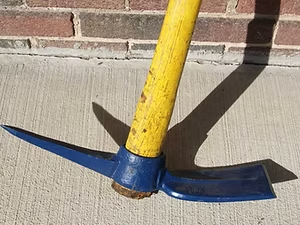
Also referred to as a Pick Axe, the Mattock is a blunt force tool that can also be used to scoop and move earth and debris. They come in a variety of shapes, this one here with a flat end similar to that of a Grub hoe or the Pulaski. Others can have a more rounded spoon-like shape. The one thing they all have in common is the thick and heavy spiked end. This can be very useful when breaking through layers of shale or other thin rock layers without the fear of doing any damage to your tools. It also can be useful when prying up roots and large rocks. Being very similar to the Pulaski, we don’t often use this tool as the spiked end may only be useful a few times while a Pulaski can be used in a larger array of situations. Somebody on our work crew usually has one in their vehicle just in case we need to do some digging in some rocky areas.
Pulaski
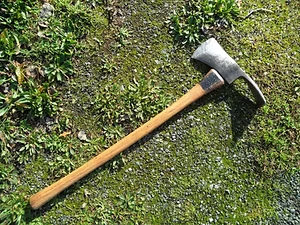
If you aren’t new to trail building, than you are probably not new to the Pulaski either. This familiar tool with an axe blade on one side, and an adze or grub hoe on the other, is probably one of the most versatile tools in our arsenal. It is great for breaking dirt, cutting roots and stumps, cutting logs, and carving out fine trail features. If you use it in a rocky area, you will quickly dull the edges, so in hard terrain it is best to drop it and pick up a pick axe.
Be careful not to smash the handle of your Pulaski on rocks and stuff. The handles on these tools are not very robust, and seem to break a lot easier than some of the other grubbing tools in this list. The heads also seem to come loose on them, so it is best to be extra cautious of your swing, and where others around you are standing.
Weed Whip
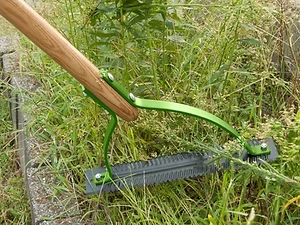
The weed whip, or as some plainly call it, a weed whacker, is a double edged blade attached to a long handle. As with other tools we use on the trail, this is yet another alternative to a powered tool. We do use powered weed-whackers when there are large areas to cover, but this handy tool is so much lighter, and requires no fuel or repair. Older children can responsibly use this tool when along for trail clearing trips. This tool isn’t intended for heavily wooded areas of the trail, but rather you’re more open areas where vines and large weeds tend to swiftly encroach on the trail throughout the spring and summer months. This tool comes in a few different shapes, this one here held by two brackets, another held by just one in a curved shape. Some have blades that are curved inwards.
Macleod
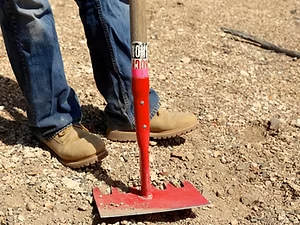
The Macleod is a tool that is almost specific to only trail building. Its sturdy rake-like design allows it to move soil, rocks and debris. It has a flat surface that can be used to pack down the trail. It can be hard to find this tool in department stores, but you can find them easily online by searching the internet. This tool is also used by fire-fighters when doing controlled burns, and to help control wild-fires. Another name for the Macleod is a Mountain Rake. We actually don’t use this tool as much as you’d think we would. Because we typically have to hike in to our locations where we work, we are limited to the number of supplies we can carry. A Pulaski is one of the tools that we tend to choose over others because of it’s versatility and strength.
Folding Saw
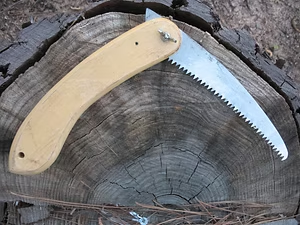
The great thing about a folding saw is that anybody can fit one in their backpack when going out for a day hike. Whether you’re on a work trip or just out for a leisurely hike, it’s nice to have one if you see a nuisance branch or small tree that has blocked a clear path on the trail. Don’t underestimate the size of this little saw. They can cut through inches of branch with little effort when used properly. Another use for this saw is when you’re digging a trail and you can’t get through a thick root. By cutting the root in two places you can surgically remove the problem rather than trying to brute force your way through it. Folding saws are sold at any tool store and some department stores. There are different sizes and can have wooden, metal or plastic handles.
Grub Hoe
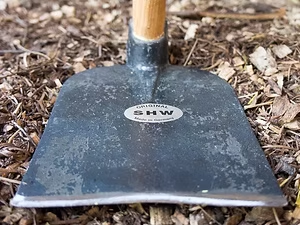
Grub hoes are available with several different head types and handle lengths. They are a light-weight tool that can be very helpful when bench-cutting a trail. This is when you are digging out the side of a sloped hill to create a level walking surface. The Grub Hoe allows you to efficiently grab and throw lots of loose dirt and debris. You might recognize that this tool shape appears on both the Mattock and Pulaski.
Although they can also be used for the same purposes, the Grub Hoe is much lighter weight as it’s not intended to be used for prying or as a blunt force tool. It can be much easier on your back and it’s less weight to carry when you’re hiking in several miles to do work.
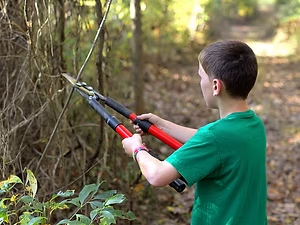
Loppers
Loppers are also known as Pruning Shears, but it’s much more fun to call them Loppers. Just as the Pulaski is our go-to tool for the ground, the Loppers are the go-to tool for the space above the trail. We usually have several Loppers in hand during our trail-clearing trips. They come in many sizes, we typically like them small because they can fit into our packs. They provide the leverage needed to cut through some of the thickest weeds and many small tree branches. We also use these to cut through thick roots when digging out a new trail. This is a photo of one of our member’s sons helping us clear some trails at Gifford Pinchot State Park. When taught how to responsibly use any of these non-powered tools, your kids can help keep our trails clear and learn to appreciate the outdoors even more.
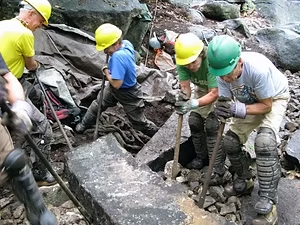
Rock Bar
The Rock Bar, or as some call it, a Digging Bar is a primitive but vital tool for trail building. The Rock Bar is nothing but a long, solid and very heavy iron bar. If you’ve ever wondered how some of the giant rocks that are used on the trail have been moved into place, it’s almost certain a Rock Bar was used to do so. Sometimes a winch is needed but with the right leverage all you need is one or two rock bars to get the job done. The rock bar can also be used for digging post holes, breaking rocks and removing stumps. Because it’s such a strong tool, it’s best to use it rather than handle tools when trying to pry up a rock or root out of the ground. Handle tools can sometimes break when trying to remove large or stubborn objects.
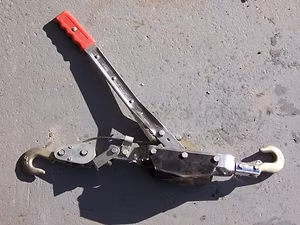
Winch
You know it’s time to get serious when someone breaks out a winch! This is a tool used to move the un-moveable. When we have to use a winch it’s usually to move very large rocks and logs. In its simplest form it consists of a spool and attached hand crank. There are many forms of Winches that can be used, this one is called a Ratchet Winch. They also go by other names such as a Come-Along, Cable Ratchet Puller or a Lever Hoist. The power of this tool comes from the leverage in the handle and the strength of the cable. We would usually loop one end of the cable around a sturdy tree, and use the crank to pull the heavy object to the desired destination. Sometimes it helps to combine this technique with the use of Rock Bars to maneuver large objects into place.
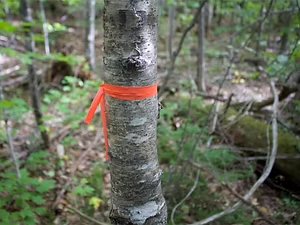
Flagging Tape/Ribbon
Flagging ribbon or tape is used when you’re planning a new trail section or re-routing a section of trail. We almost always use orange as it’s an easy to spot color from a distance. Flagging a re-route or new section is more easily done in the fall or winter when there isn’t much foliage to hinder the view and there’s less vegetation to walk through. Some of our work trips have been exploratory trips where we flagged new trail areas. It’s important to be well aware of property lines and park boundaries. When we go out on flagging trips we are well prepared with paper maps and GPS. The GPS not only allows us to know exactly where we are, but also helps make a digital track that we can use to review the location back at home.